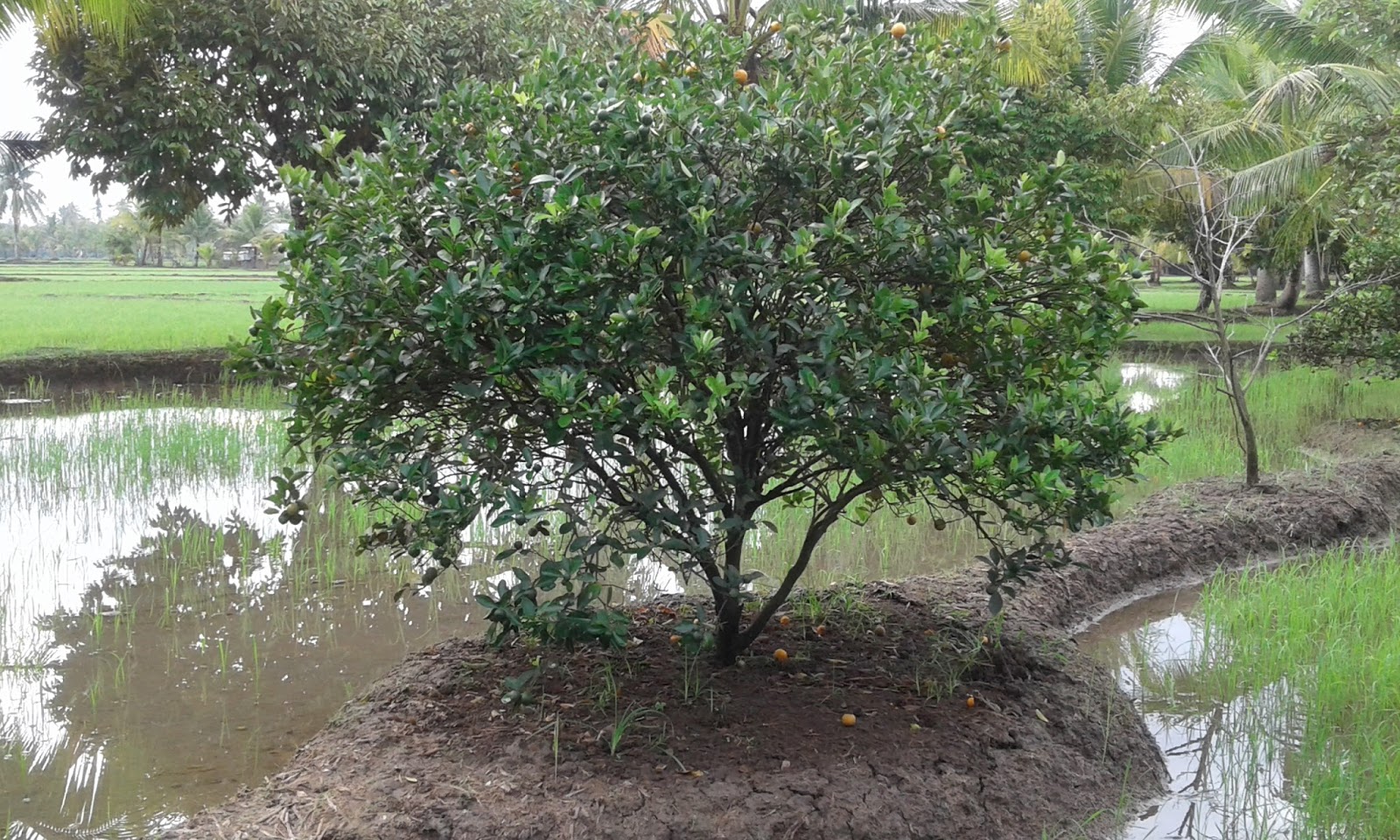
Calamansi (Calamondin) - planted in my farm
This calamansi tree is grafted from a mother tree and is planted on
the rice paddy in my farm through a mound of earth so that its roots will
not be submerged in water for the area is an irrigated riceland where rice
is also grown.
Calamondin (Citrofortunella
microcarpa or Citrofortunella mitis) is an important
citrofortunella,
meaning that it is an intergenetic hybrid between
a member of the
genus Citrus (in this case probably the mandarin orange) and the kumquat, formerly
considered as belonging to a separate
genus Fortunella. Calamondin is used mainly
as an ornamental tree, rather
than for food, although the fruit is edible.
Calamondin
is called by many names, including: calamonding, calamondin orange, calamansi, calamandarin, goldenlime, kalamunding, kalamansi,
Philippine lime,
Panama orange, Chinese
orange, musk orange and acid orange.
Calamondin
is widely cultivated in the Philippines, where it is called kalamansi by
the Tagalogs, kalamunding or calamansi by the Kapampangans, and limonsito or
simuyaw, by
the Visayans.
In Malaysia it
is known as limau kasturi. Calamondin also
grows in the northern parts
of Indonesia and
southern China. It is available all
year-round in the Philippines and is usually seen in its
unripened green state. When
left to ripen it turns a tangerine orange. Calamondin
is usually used in its not-so-ripe
stage as sour seasoning for many Southeast
Asian food such as the shomai. The fruits
are sour and are often used for preserves or
cooking.
In Asian cuisines, the juice is used to season fish, fowl, and pork. It is very
commonly
used as a condiment in Filipino cuisine like pancit or lugaw, or in the
basic sawsawan
(dip) of calamansi juice and soy sauce/fish sauce,
for fish, spring rolls, dumplings and
various meats.
The
fruit is used in local recipes in northern Indonesia,
especially around the North
Sulawesi region. Fish are spritzed with the juice prior to
cooking to eliminate the "fishy"
smell. Kuah
asam ("sour soup") is a regional clear fish broth made with
calamondin juice.
Calamansi fruits
Ripened calamansi fruits
DURIAN - planted in my farm
This durian tree is grafted from a mother tree and is planted on the
rice paddy in my farm through a mound of earth so that its roots will not
be submerged in water for the area is an irrigated riceland where rice is
also grown. The tree does not grow very tall and fruits can just be hand
picked while standing on the ground.
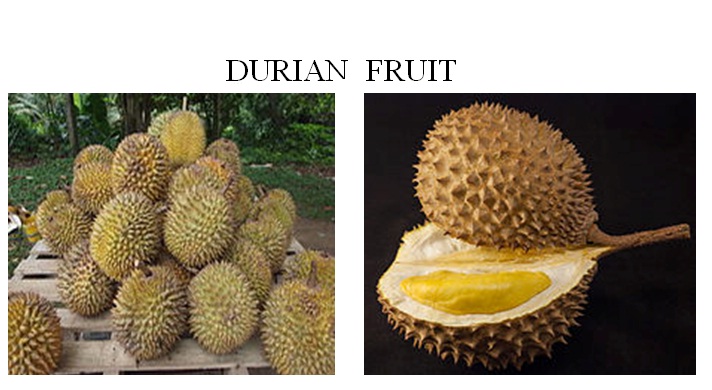
Durian
The durian is
the fruit of several tree species belonging to the genus Durio. There
are 30 recognised Durio species, at least nine of which produce edible
fruit, and
over 300 named varieties in Thailand and 100 in Malaysia. Durio zibethinus is the
only species available in the international
market: other species are sold in their local
regions.
Regarded
by many people in southeast Asia as the notorious "king
of fruits", the durian
is distinctive for its large size,
strong odor,
and formidable thorn-covered rind.
The fruit
can grow as large as 30 centimetres long and 15 centimetres in
diameter, and it typically
weighs one to three kilograms. Its shape ranges
from oblong to round, the colour of its
husk green to brown, and its flesh pale
yellow to red, depending on the species.
Some
people regard the durian as having a pleasantly sweet fragrance, whereas others
find the aroma overpowering with an unpleasant odour. The smell evokes
reactions from
deep appreciation to intense disgust, and has been described
variously as rotten onions,
turpentine,
and raw sewage. The persistence of its odour, which may linger for several
days, has led to the fruit's banishment from certain hotels and public
transportation in
Southeast Asia. By contrast, the nineteenth-century
British naturalist Alfred Russel
Wallace, described its flesh
as "a rich custard highly flavoured with almonds".
The
flesh can be consumed at various stages of ripeness, and it is used to
flavour a wide
variety of savoury and sweet desserts in Southeast Asian cuisines. The seeds can also
be eaten when cooked.
Durian flower


Durian fruit
Durian fruit
RC 222 rice variety - planted in my farm
Golden rice
IRRI – International Rice Research
Institute in Los Baños, Laguna, Philippines
is pursuing the development of "golden rice".
Geneticists inserted a gene into
the rice plant that allows it to produce beta carotene,
which makes its grains
yellow. Because the human body converts beta carotene
to vitamin A, golden
rice has the potential to dramatically improve the lives of millions of
people
around the world, particularly in Africa and Southeast Asia, where vitamin
A-deficiency is an especially
common malady that can cause blindness and
increases the risk of death from
disease. Children are particularly vulnerable;
according to the World Health Organization (WHO), "An
estimated 250,000
to 500,000 vitamin A-deficient children become blind every
year, half of
them dying within 12 months of losing their sight". In
August 2013,
anti-genetically modified organism protestors
broke into IRRI's research facilities
and destroyed field trials of golden
rice. The Bill and Melinda Gates Foundation
supports
IRRI in its development of golden rice.
IRRI's headquarters in the Philippines
is located on a 252 hectares (620 acres)
experimental farm with modern
laboratories and glasshouses, and a training
center. The land is owned by
the University of the Philippines and
is leased
to the Institute. It also houses the International Rice Genebank and
Riceworld
Museum. The International Rice Genebank holds more than 127,000
rice accessions
and wild relatives and is the biggest collection of rice genetic
diversity in
the world.
COCONUTS - planted in my farm
Coconut
Coconut trees are grown in tropical countries mainly for the high oil content of the
endosperm (copra), which is widely used in both food and non-food industries (e.g.
margarine and soaps). Large production areas, in particular, are found along the coastal
regions in the wet tropical areas of Asia in the Philippines, Indonesia, India, Sri Lanka
and Malaysia. In these countries millions of people make a living from the coconut
palm and its many products.
Coir
fibres are extracted from the husks surrounding the coconut. In most
areas coir
is a by-product of copra production, and the husks are left on the
fields as a mulch or
used as fertilizer because of high potash content. India
and Sri Lanka are the main
countries where coir is extracted by traditional
methods for the commercial production
of a variety of products, including
brushes and brooms, ropes and yarns for nets and
bags and mats, and padding for
mattresses. However, world wide only a small
part of the fibres available are
currently used for these purposes. The average fibre
yield is
dependent on geographical area and the variety of the coconut tree. In the
south of India and Sri Lanka, for example, where the best quality fibres are
produced the average yield is 80-90 g fibre per husk. Caribbean husks, by
contrast,
are relatively thick and may yield up to 150 g of fibre.


Charcoal
Coconuts
shells, which comprises 12 per cent of the weight of the coconut, could be
utilized more efficiently. Commercial production of charcoal from the coconut
shell
provides for an increasingly important export market for cocos producing
areas.
Carbonization of one tonne of coconut shells produces of the order 300
kg of charcoal,
which can be converted into 120 kg of activated carbon. The
combustion of waste
gases can be utilized to enhance the efficiency of the
processes and to generate power.
The market for activated carbon in filter
materials, absorbents and similar uses could
be increased substantially if
controlled processing and product certification were
available. An alternative
domestic application for charcoal could be as fuel for cooking
or for drying
agricultural products (for example, copra and/or coir).
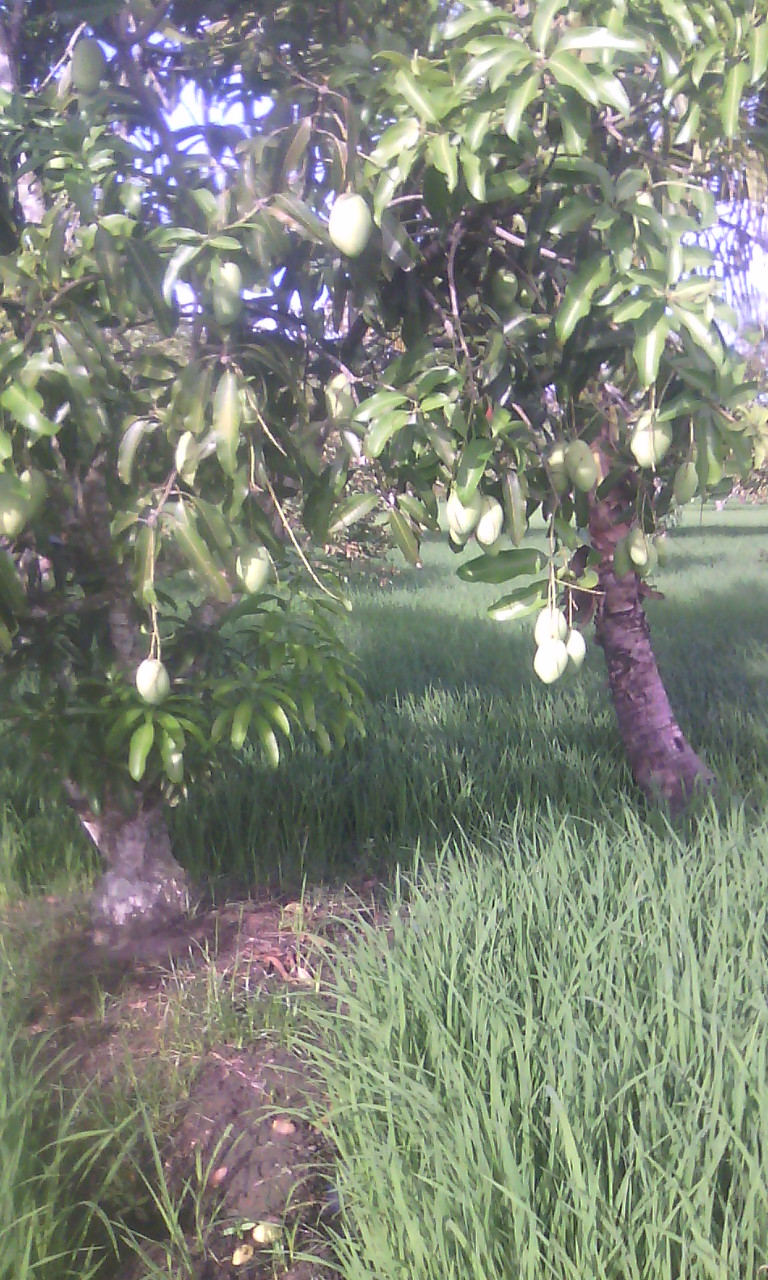
Mango ( Cebu )
These mangoes are also grafted from a mother tree and are planted on a mound
of earth along the rice paddies of a ricefield. These mango variety is from Cebu. The
mango trees are intercrop with coconuts in the ricefield.
Mango (Cebu )